Byblos, Lebanon: War, earthquakes, tourism | The Guardian

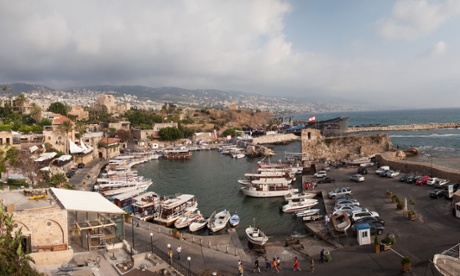
‘Byblos escaped more than a tornado ... we escaped a civil war,’ ... the port of Byblos, Lebanon. Photograph: James Haines-Young

‘Byblos escaped more than a tornado … we escaped a civil war,’ … the port of Byblos, Lebanon. Photograph: James Haines-Young

[Published here August 28, 2014]

Ten minutes before sunset, the muezzin’s call to prayer goes out over the megaphones. In the summer heat, the bustle of Byblos pauses for a moment, then quickly resumes. Fresh fish is slapped onto steaming grills, beer is poured into iced glasses, and visitors – both Lebanese and foreign – stroll through the cobblestone pathways of what is reputed to be the world’s oldest continually inhabited city.

For perhaps 7,000 years it has been thus, in one form or another. People have lived in this picturesque coastal city in the north of Lebanon probably longer than any other. It is home to ruins from the Phoenicians, Romans, Byzantines, Crusaders and others. It was the launching point for the spread of the modern European alphabet. In the swinging 1960s, it emerged as a leisure destination where Brigitte Bardot frolicked in the marinas along with other icons of the decade. To this day, late-night outdoor bars and restaurants continue to thrive.

Continue reading

Negotiations for Islamic State’s Lebanese hostages turn sour | NOW News

Jabhat al-Nusra

Jabhat al-Nusra

[Published here August 24, 2014]

After some initial success, negotiations for the release of over 30 Lebanese hostages held by the Islamic State and Jabhat al-Nusra took a turn for the worse this weekend, when the Lebanese religious institution mediating the talks suspended their involvement. Citing challenges in securing the militants’ demands, the Muslim Scholars Committee said it would “make way for other intermediaries” to get involved. But with the militants reportedly refusing to work with anyone but the committee, the hostage negotiations may be in freefall.

Continue reading

Negotiations for Islamic State’s Lebanese hostages turn sour | NOW News

[Published here on August 24, 2014]

After some initial success, negotiations for the release of over 30 Lebanese hostages held by the Islamic State and Jabhat al-Nusra took a turn for the worse this weekend, when the Lebanese religious institution mediating the talks suspended their involvement. Citing challenges in securing the militants’ demands, the Muslim Scholars Committee said it would “make way for other intermediaries” to get involved. But with the militants reportedly refusing to work with anyone but the committee, the hostage negotiations may be in freefall.

Continue reading

A game-changer in eastern Lebanon | Al Jazeera

Lebanese Armed Forces on the way to Arsal. Image by Reuters.

Lebanese Armed Forces on the way to Arsal. Image by Reuters.

[Published here August 4, 2014]

Just before noon on August 2, in the Lebanese border town of Arsal, the Lebanese Armed Forces (LAF) arrested Abu Ahmad al-Jumaa, a Syrian rebel commander who had recently pledged allegiance to the extremist Islamic State group. His arrest sparked a number of clashes in the largely Sunni Bekaa town between his supporters and Lebanese security forces stationed in the area. But Jumaa’s story and the significance of the August 2 events have repercussions beyond the small Lebanese town.

Continue reading

Refugees in their own homeland | Executive Magazine

A Lebanese refugee who had been living in Syria. Image by James Haines-Young

A Lebanese refugee who had been living in Syria. Image by James Haines-Young

[Published here June 5, 2014]

Halima Zaroubi, a frail 80-something-year-old woman, breaks into tears when describing what’s happened to her home. “Our houses are gone, our lands have dried up,” her voice cracks. “Everything’s gone.” Since the outbreak of the Syrian civil war, millions of people have been forced from their homes. However, Syrians are not alone in having to escape the country’s overwhelming violence. Lebanese by birth and by nationality, Zaroubi had been living in Qusayr, a border town in Syria’s Damascus province, for 60 years. Like tens of thousands of other Lebanese who lived and worked in Syria for decades, Zaroubi and her family were forced to leave and settle back in their native country. But rather than settling back into their native land as citizens, they now live like refugees in their own country.

Continue reading

Syrians in Lebanon cast votes amid traffic, army violence | NOW News

[Published here May 25, 2014]

SYRIAN EMBASSY, Yarzeh — Hundreds of thousands of Syrians today headed to the Syrian embassy in Yarzeh, southeast of Beirut, to cast their vote for Syria’s next president. The Hazmieh highway was clogged with cars as early as 8 a.m.; drivers waved the Syrian flag out of cars plastered with posters of Syrian president and incumbent candidate Bashar al-Assad. But chaos at the embassy and a disorganized voting process complicated many Syrians’ attempts to vote.

Continue reading

Dekkenet al-Balad opens in Gemmayze | NOW News

[Published here May 15, 2014]

Driving licenses, university diplomas, and votes: everything’s for sale, even your rights. Such is the motto of Dekkenet al-Balad, which translates to “Country Store,” the newly opened storefront on Beirut’s Gemmayze Street. Neatly stacked throughout the small shop are buckets full of forged Lebanese ID cards, binders labeled “List of government positions for Maronites only,” and stacks of counterfeit Lebanese government paperwork. A young employee hurriedly sifts through a cardboard box to find a customer precisely the document she needs – for a fee, of course.

Continue reading

Syrian Kurds find no solace in Lebanon | NOW News

[Published here on May 13, 2014]

Abdul Samih, his wife Fidan, and his five children live in a small, shabby apartment in the St. Simon neighborhood of southwest Beirut. To reach his tiny home, he weaves through narrow alleyways of Hezbollah flags, martyrdom posters, and burly Lebanese men looking on suspiciously at him. Not only is Abdul Samih a Syrian refugee, but he is ethnically Kurdish – making him double the outsider for many Lebanese.

Continue reading

Lebanon Stuck Between Leaky Borders and Politics | Atlantic Council

Atlantic Council

Atlantic Council

[Published here March 4, 2014]

A twenty year-old girl and a ten-year old boy were killed by Syrian government airstrikes last week. It would sound like any other day in Syria, except these strikes took place on the Lebanese side of the border, killing two Lebanese civilians and wounding several others. Porous borders are not new to Lebanon. The Lebanese and Syrian national borders have yet to be properly demarcated, and have never been fully secured. Migrant Syrian workers used to pour into Lebanon, while Lebanese looking for a quiet escape into old Damascus would flow the other way.

Continue reading

Lebanese border town overwhelmed by Syrian war, refugees | Al-Monitor

almon

[Published here February 18, 2014]

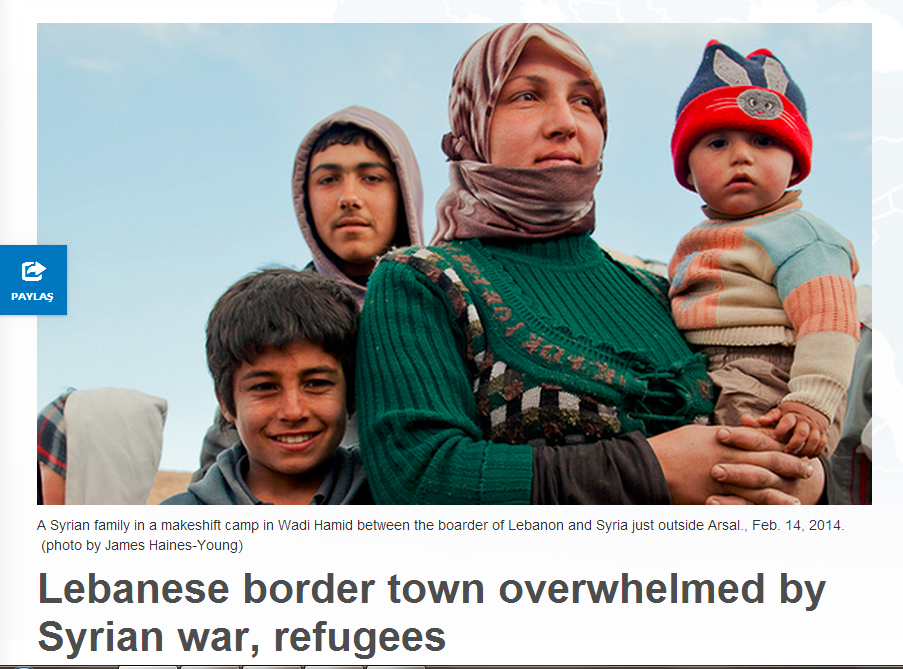
ARSAL, Lebanon — The once sleepy little town of Arsal lies in the far east of the arid Bekaa Valley, along the Lebanese-Syrian border. With its unpaved roads and half-finished stone buildings, Arsal had been a typical dusty and isolated border town, but since the beginning of the uprising in neighboring Syria, it has taken on a much larger role: It is now host to a Syrian refugee population that is more than double the size of the town’s Lebanese residents. Arsal is cracking under the pressure.

Continue reading