Refugees in their own homeland | Executive Magazine

A Lebanese refugee who had been living in Syria. Image by James Haines-Young

A Lebanese refugee who had been living in Syria. Image by James Haines-Young

[Published here June 5, 2014]

Halima Zaroubi, a frail 80-something-year-old woman, breaks into tears when describing what’s happened to her home. “Our houses are gone, our lands have dried up,” her voice cracks. “Everything’s gone.” Since the outbreak of the Syrian civil war, millions of people have been forced from their homes. However, Syrians are not alone in having to escape the country’s overwhelming violence. Lebanese by birth and by nationality, Zaroubi had been living in Qusayr, a border town in Syria’s Damascus province, for 60 years. Like tens of thousands of other Lebanese who lived and worked in Syria for decades, Zaroubi and her family were forced to leave and settle back in their native country. But rather than settling back into their native land as citizens, they now live like refugees in their own country.

Continue reading

US steps closer to arming vetted Syrian rebels | NOW News

[Published here June 2, 2014]

The American government may be getting closer to a broad train-and-equip program for vetted members of Syria’s armed opposition, according to US officials. The plan would constitute a move from a Title 50 action, run covertly by the Central Intelligence Agency and training a very limited number of rebels, to a Title 10 action run overtly by the Department of Defense that would target more scrutinized groups.

Continue reading

Syrians in Lebanon cast votes amid traffic, army violence | NOW News

[Published here May 25, 2014]

SYRIAN EMBASSY, Yarzeh — Hundreds of thousands of Syrians today headed to the Syrian embassy in Yarzeh, southeast of Beirut, to cast their vote for Syria’s next president. The Hazmieh highway was clogged with cars as early as 8 a.m.; drivers waved the Syrian flag out of cars plastered with posters of Syrian president and incumbent candidate Bashar al-Assad. But chaos at the embassy and a disorganized voting process complicated many Syrians’ attempts to vote.

Continue reading

Dekkenet al-Balad opens in Gemmayze | NOW News

[Published here May 15, 2014]

Driving licenses, university diplomas, and votes: everything’s for sale, even your rights. Such is the motto of Dekkenet al-Balad, which translates to “Country Store,” the newly opened storefront on Beirut’s Gemmayze Street. Neatly stacked throughout the small shop are buckets full of forged Lebanese ID cards, binders labeled “List of government positions for Maronites only,” and stacks of counterfeit Lebanese government paperwork. A young employee hurriedly sifts through a cardboard box to find a customer precisely the document she needs – for a fee, of course.

Continue reading

Syrian Kurds find no solace in Lebanon | NOW News

[Published here on May 13, 2014]

Abdul Samih, his wife Fidan, and his five children live in a small, shabby apartment in the St. Simon neighborhood of southwest Beirut. To reach his tiny home, he weaves through narrow alleyways of Hezbollah flags, martyrdom posters, and burly Lebanese men looking on suspiciously at him. Not only is Abdul Samih a Syrian refugee, but he is ethnically Kurdish – making him double the outsider for many Lebanese.

Continue reading

Meet 140journos, the Twitter group trying to prove election fraud in Turkey | GlobalPost

140journos send out requests for ballot report photos and review them in an Istanbul flat on March 31. Image via Ogulcan Ekiz

140journos send out requests for ballot report photos and review them in an Istanbul flat on March 31. Image via Ogulcan Ekiz

[Published here April 8, 2014]

ISTANBUL, Turkey — Spread around a tiny living room in an Istanbul flat are laptops, cell phones, projectors, and almost three dozen social media activists. This group, which spent all day monitoring Turkey’s contested local elections on March 30, re-assembled in a matter of hours after the governing Justice and Development Party (AKP) declared its victory in the early morning of March 31. Their mission: to carry out a citizen-run investigation into election fraud.

Named after the 140-character limit on micro-blogging site Twitter, 140journos gained prominence after Istanbul’s Gezi Park protests last year. It has since grown to a network of over 300 citizen journalists, all volunteers, based throughout Turkey. The group uses Twitter, as well as Facebook and micro-video sites like Vine, to gather and verify local news. According to Ogulcan Ekiz, one of the group’s founding members, 140journos’ verification process has earned it the trust of much of Turkey’s youth, who see biases in traditional Turkish media.

Continue reading

Suicide in Kurdistan | The Economist

[Published here March 18, 2014]

ON MARCH 8th, while the world celebrated International Women’s Day to recognise progress in women’s rights, two women in Iraqi Kurdistan set themselves on fire. Self-immolation as a dramatic and deadly form of protest by women is known across the Middle East, from Egypt to Pakistan. But it has become alarmingly common in the Kurdish region of northern Iraq. By some estimates self-burning has claimed the lives of as many as 10,000 women, including girls as young as 13, since the region gained autonomy in 1991.

Continue reading

Lebanon Stuck Between Leaky Borders and Politics | Atlantic Council

Atlantic Council

Atlantic Council

[Published here March 4, 2014]

A twenty year-old girl and a ten-year old boy were killed by Syrian government airstrikes last week. It would sound like any other day in Syria, except these strikes took place on the Lebanese side of the border, killing two Lebanese civilians and wounding several others. Porous borders are not new to Lebanon. The Lebanese and Syrian national borders have yet to be properly demarcated, and have never been fully secured. Migrant Syrian workers used to pour into Lebanon, while Lebanese looking for a quiet escape into old Damascus would flow the other way.

Continue reading

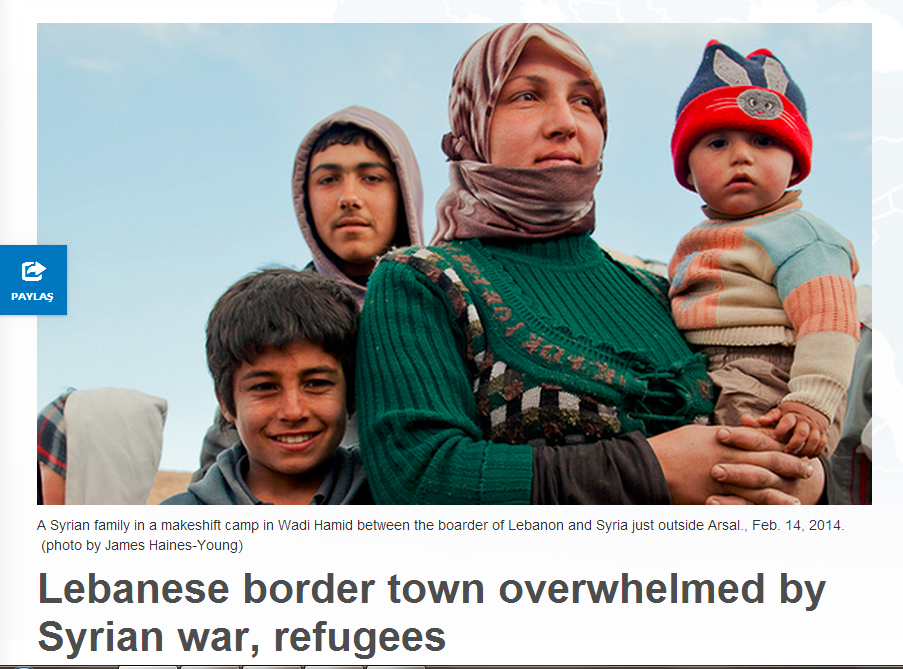
Lebanese border town overwhelmed by Syrian war, refugees | Al-Monitor

almon

[Published here February 18, 2014]

ARSAL, Lebanon — The once sleepy little town of Arsal lies in the far east of the arid Bekaa Valley, along the Lebanese-Syrian border. With its unpaved roads and half-finished stone buildings, Arsal had been a typical dusty and isolated border town, but since the beginning of the uprising in neighboring Syria, it has taken on a much larger role: It is now host to a Syrian refugee population that is more than double the size of the town’s Lebanese residents. Arsal is cracking under the pressure.

Continue reading