Can legal changes stop trafficking in Yemen? | IRIN News

Can legal changes stop trafficking in Yemen?

Can legal changes stop trafficking in Yemen?

[Published here September 9, 2014]

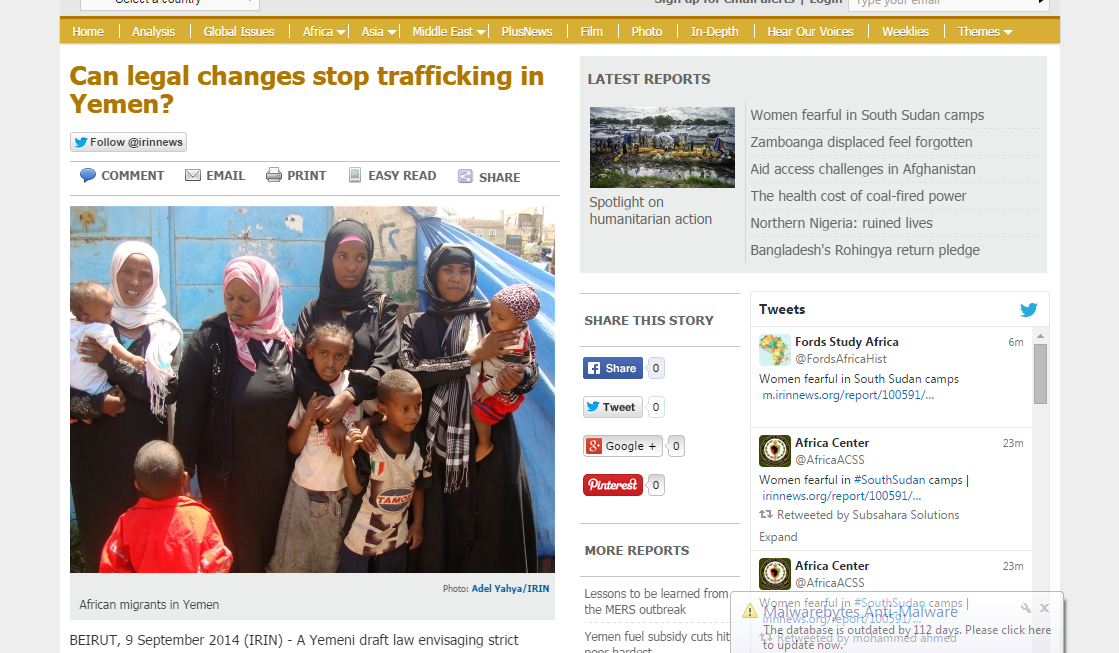
BEIRUT, 9 September 2014 (IRIN) – A Yemeni draft law envisaging strict penalties for those involved in trafficking migrants, including kidnapping them and demanding ransom, may finally bring an end to decades of exploitation.

To give the process a push, the International Labour Organization (ILO) co-hosted a three-day workshop from 6-8 September with Yemen’s Ministry of Human Rights in Lebanon’s capital Beirut, bringing together government entities, international agencies, and non-governmental groups to develop Yemen’s anti-trafficking roadmap.

Continue reading

Byblos, Lebanon: War, earthquakes, tourism | The Guardian

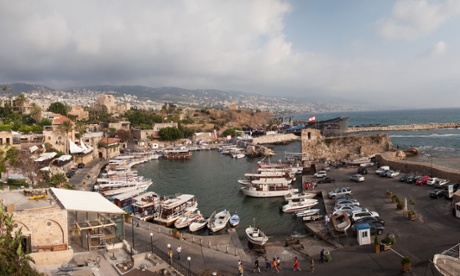
‘Byblos escaped more than a tornado ... we escaped a civil war,’ ... the port of Byblos, Lebanon. Photograph: James Haines-Young

‘Byblos escaped more than a tornado … we escaped a civil war,’ … the port of Byblos, Lebanon. Photograph: James Haines-Young

[Published here August 28, 2014]

Ten minutes before sunset, the muezzin’s call to prayer goes out over the megaphones. In the summer heat, the bustle of Byblos pauses for a moment, then quickly resumes. Fresh fish is slapped onto steaming grills, beer is poured into iced glasses, and visitors – both Lebanese and foreign – stroll through the cobblestone pathways of what is reputed to be the world’s oldest continually inhabited city.

For perhaps 7,000 years it has been thus, in one form or another. People have lived in this picturesque coastal city in the north of Lebanon probably longer than any other. It is home to ruins from the Phoenicians, Romans, Byzantines, Crusaders and others. It was the launching point for the spread of the modern European alphabet. In the swinging 1960s, it emerged as a leisure destination where Brigitte Bardot frolicked in the marinas along with other icons of the decade. To this day, late-night outdoor bars and restaurants continue to thrive.

Continue reading

Negotiations for Islamic State’s Lebanese hostages turn sour | NOW News

Jabhat al-Nusra

Jabhat al-Nusra

[Published here August 24, 2014]

After some initial success, negotiations for the release of over 30 Lebanese hostages held by the Islamic State and Jabhat al-Nusra took a turn for the worse this weekend, when the Lebanese religious institution mediating the talks suspended their involvement. Citing challenges in securing the militants’ demands, the Muslim Scholars Committee said it would “make way for other intermediaries” to get involved. But with the militants reportedly refusing to work with anyone but the committee, the hostage negotiations may be in freefall.

Continue reading

Negotiations for Islamic State’s Lebanese hostages turn sour | NOW News

[Published here on August 24, 2014]

After some initial success, negotiations for the release of over 30 Lebanese hostages held by the Islamic State and Jabhat al-Nusra took a turn for the worse this weekend, when the Lebanese religious institution mediating the talks suspended their involvement. Citing challenges in securing the militants’ demands, the Muslim Scholars Committee said it would “make way for other intermediaries” to get involved. But with the militants reportedly refusing to work with anyone but the committee, the hostage negotiations may be in freefall.

Continue reading

The Struggle of Female-Led Syrian Refugee Households | VICE

From left to right: Jilan, 16, and Iman, 17, who live in the Domiz refugee camp. Image by James Haines-Young

From left to right: Jilan, 16, and Iman, 17, who live in the Domiz refugee camp. Image by James Haines-Young

[Published here August 4, 2014]

Since the beginning of the conflict more than three years ago, Syria’s death toll sits horrifyingly somewhere over 120,000. But the real number of destroyed lives is much higher: Three million refugees, scattered throughout the region, escaped the war alive. Though they survived, their homes have been demolished, their memories faded, and their dreams rendered impossible. Painstakingly, some women who turned into widows or single parents have tried to reassemble their lives, readjusting hopes and goals to fit a harsh new reality. Here is one story of a women-led household—a rare occurrence in the Middle East—inside the Domiz refugee camp in Iraq.

Continue reading

A game-changer in eastern Lebanon | Al Jazeera

Lebanese Armed Forces on the way to Arsal. Image by Reuters.

Lebanese Armed Forces on the way to Arsal. Image by Reuters.

[Published here August 4, 2014]

Just before noon on August 2, in the Lebanese border town of Arsal, the Lebanese Armed Forces (LAF) arrested Abu Ahmad al-Jumaa, a Syrian rebel commander who had recently pledged allegiance to the extremist Islamic State group. His arrest sparked a number of clashes in the largely Sunni Bekaa town between his supporters and Lebanese security forces stationed in the area. But Jumaa’s story and the significance of the August 2 events have repercussions beyond the small Lebanese town.

Continue reading

How ISIL is gaming the world’s journalists | GlobalPost

Tweets from Islamist fighters.

Tweets from Islamist fighters.

[Published here June 25, 2014]

BEIRUT, Lebanon — “Just don’t make us out as if we’re beasts and terrorists, you know? We’ve got families like you, we’ve got sisters like you, and you’ve probably got brothers like me.”

Despite his earnest tone, there aren’t many who have a brother like Abu Sumayyah.

An ethnic Kashmiri raised in the UK, Sumayyah has been living in Syria for about a year and recently pledged allegiance to the Islamic State in Iraq and the Levant (ISIL or ISIS), the powerful Al Qaeda-inspired group making gains in Syria and Iraq.

After discussing his reasons for waging jihad in Syria, Abu Sumayyah was keen to make sure I left the interview with a positive impression of ISIL. “Be a good journalist and portray the truth, not what [others] want you to portray,” he said.

Like Sumayyah, ISIL members — from the leadership down to supporters abroad — are using social media to propagate a carefully-crafted narrative about ISIL. In the process, they’ve made themselves increasingly accessible online by tweeting, following, direct-messaging — and even in some cases successfully manipulating — foreign journalists.

Continue reading